
Sex Offender Checks in Calhoun County
The Texas Public Sex Offender Registry is the main public channel for a Calhoun County sex offender check. Texas DPS consolidates information sent by local registration authorities and publishes the allowed fields in a free statewide search. A reader may search by a person's name or use geographic controls such as city, ZIP code, county, address, and radius. The result is a public registry record, not a broad criminal-history report.
Local roles depend on residence. Port Lavaca Police registers residents inside that city. The county authority handles people in unincorporated Calhoun County, while another incorporated city acts through its own local law-enforcement authority. For an address that crosses a city boundary or looks wrong, contact the registering agency shown on the profile. The registry depends on local submissions, so the agency closest to the registration process is the right place for a current-process question.
How to Search the Texas Public Sex Offender Registry
The Texas DPS search offers two useful paths. A name search works when the person is known, while a geographic search helps a reader review a Calhoun County area. Use several identifiers before treating a result as the intended person. Names and aliases can overlap, and an address-based map reflects submitted registration data rather than a live location.
- Open the official DPS registry and read its notices before searching.
- Enter a name, or choose an address, city, ZIP code, Calhoun County, and a listed radius for a geographic search.
- Switch between list and map views as needed, then compare photos, aliases, age, physical descriptors, and location details.
- Open the full profile, review status and registering agency, and use subscription controls when a record offers them.
| Field Label | Type | Required | Notes |
|---|---|---|---|
| Last Name | Text | Name path | Starts a person search |
| First Name | Text | Optional | Narrows a name result |
| Address | Text | Geographic path | Sets the center for a mapped search |
| City / ZIP Code | Text or select | Optional | Narrows the geographic area |
| County | Select | Optional | Select Calhoun County |
| Radius | Select | Geographic path | Use a distance offered in the live portal |
| Map / List | View tabs | No | Changes how results are displayed |
The official registry search screen shows the public controls without requiring a third-party service.
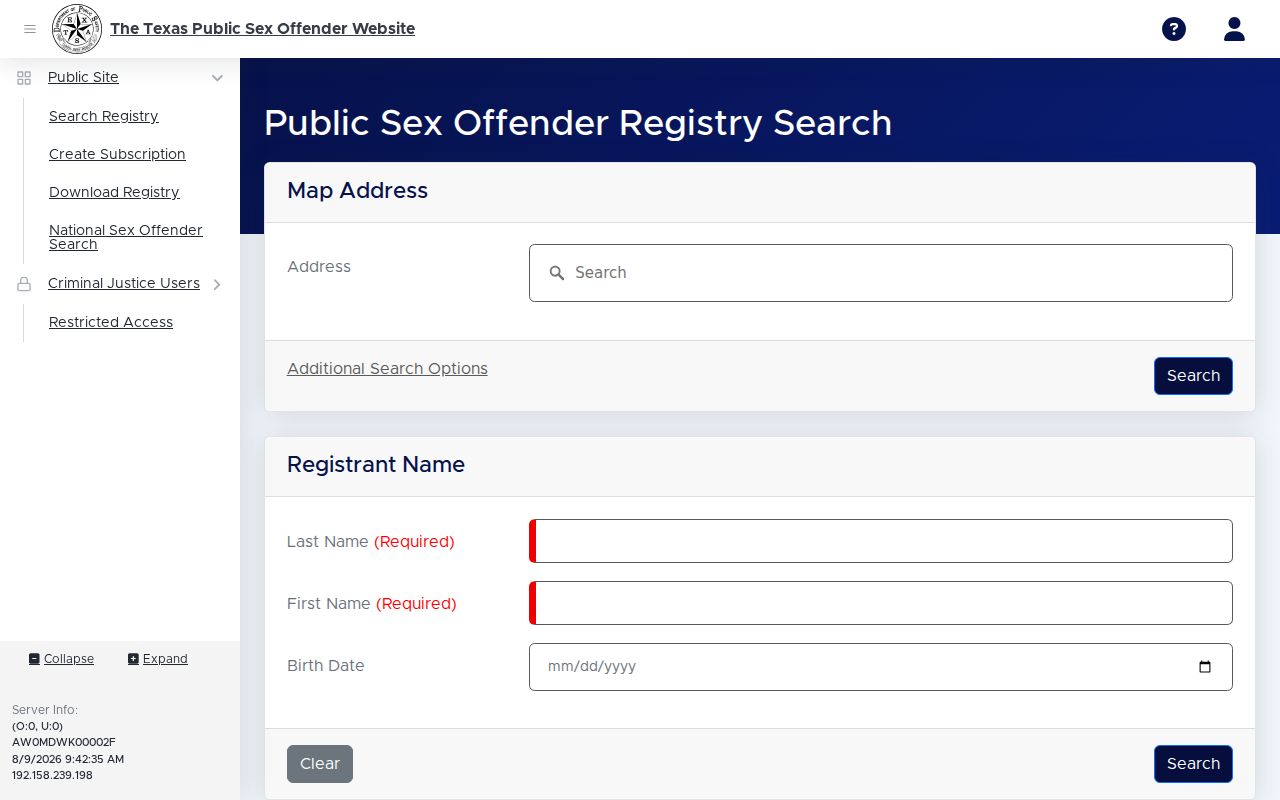
The search screen makes the name and geographic paths distinct, which helps a reader choose fields that fit the question.
Calhoun County Registry Map Limits
A map pin is a search aid. It is not proof of a person's present physical location, and it should not be read as continuous tracking. The location comes from registration data submitted through local authorities. Changes, processing time, and the way a residence is described can affect what the map shows.
Use the list view with the map. Compare the registering agency, status, address wording, and profile update information. If a Calhoun County map result conflicts with direct knowledge or seems stale, contact the authority named in the record. Do not confront the person or household. The DPS map and list interface illustrates both public views.
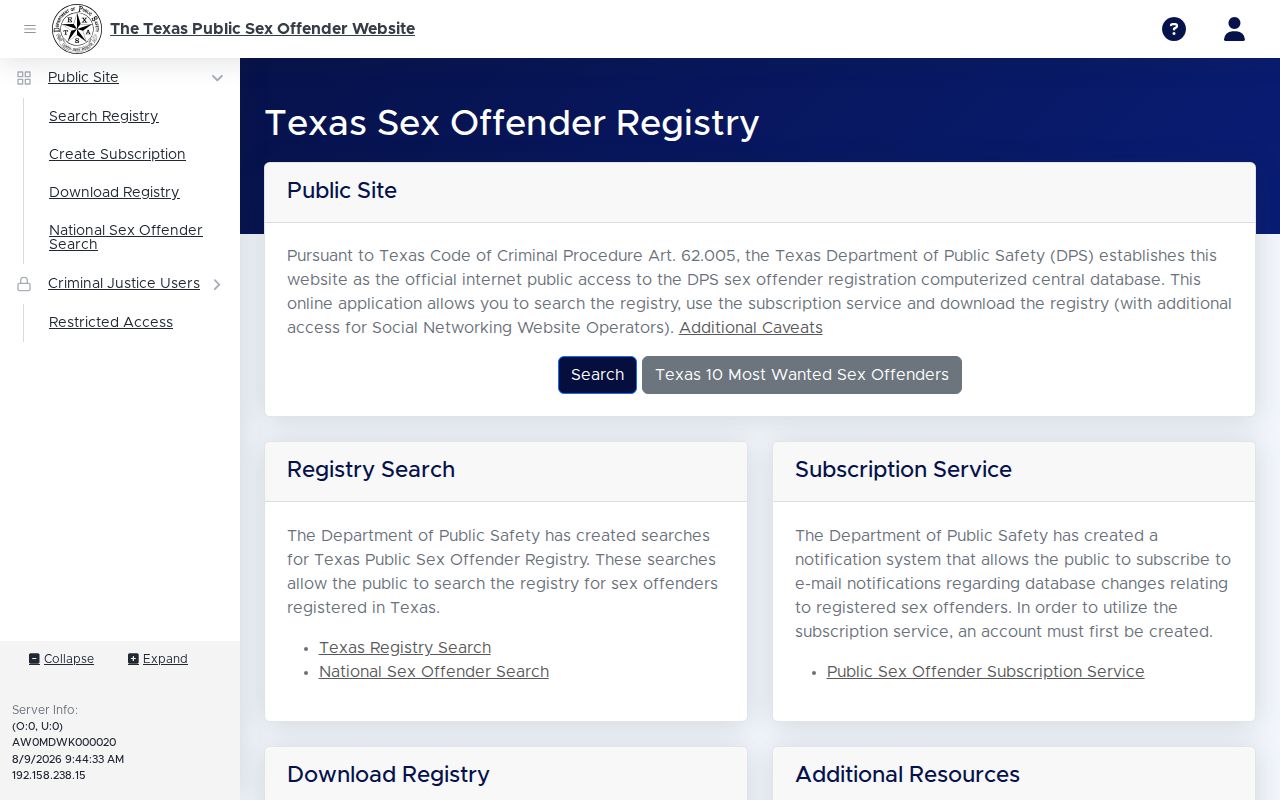
Reading both views reduces the risk of treating one plotted point as a complete account of a registration record.
Note: Registry mapping supports community awareness, but local law enforcement remains the source for current registration-process questions.
Inside a Registry Profile
A public Texas profile can contain identity, physical-description, location, offense, status, and supervision information. It may also show school or higher-education details, scars or tattoos, certain vehicle data, and subscription controls. Read each field in context. A conviction or adjudication date is not the same as the date of a later address update, and risk level does not state the length of the registration duty.
| Name & Aliases | Full name and reported aliases used to distinguish possible matches |
|---|---|
| Photo & Description | Current photograph when published, age or birth data, sex, race, height, weight, hair, eyes, and other descriptors |
| Registered Location | Residence address or a described geographic location, subject to the portal's notices |
| Offense Details | Offense description, statute, conviction or adjudication date, victim age category, punishment, and supervision status when published |
| Risk & Agency | Texas risk level and the law-enforcement authority responsible for registration |
| Status & Updates | Registration or compliance status and available record-update or subscription controls |
| Other Identifiers | Scars, marks, tattoos, school information, and certain vehicle details when collected and public |
DPS collects more than it releases. Social Security and driver-license numbers, phone numbers, online identifiers, employer contact details, victim identity, and other protected information are not public profile fields. A court may also make qualifying juvenile information nonpublic.
Calhoun County and NSOPW
The Texas portal covers the state's public registry data. It does not replace a search across other states, territories, or participating tribal jurisdictions. The U.S. Department of Justice operates the National Sex Offender Public Website, known as NSOPW, as the official multijurisdiction layer. Use it when a personal safety question crosses state lines or a person may have lived elsewhere.
NSOPW does not create a second Calhoun County profile. It routes searches across participating public registries, each subject to its own laws and publication rules. That means search coverage and displayed fields can differ. Return to Texas DPS for the Texas record and to the profile's registering agency for a local process question.
The official national search landing page explains that broader role.
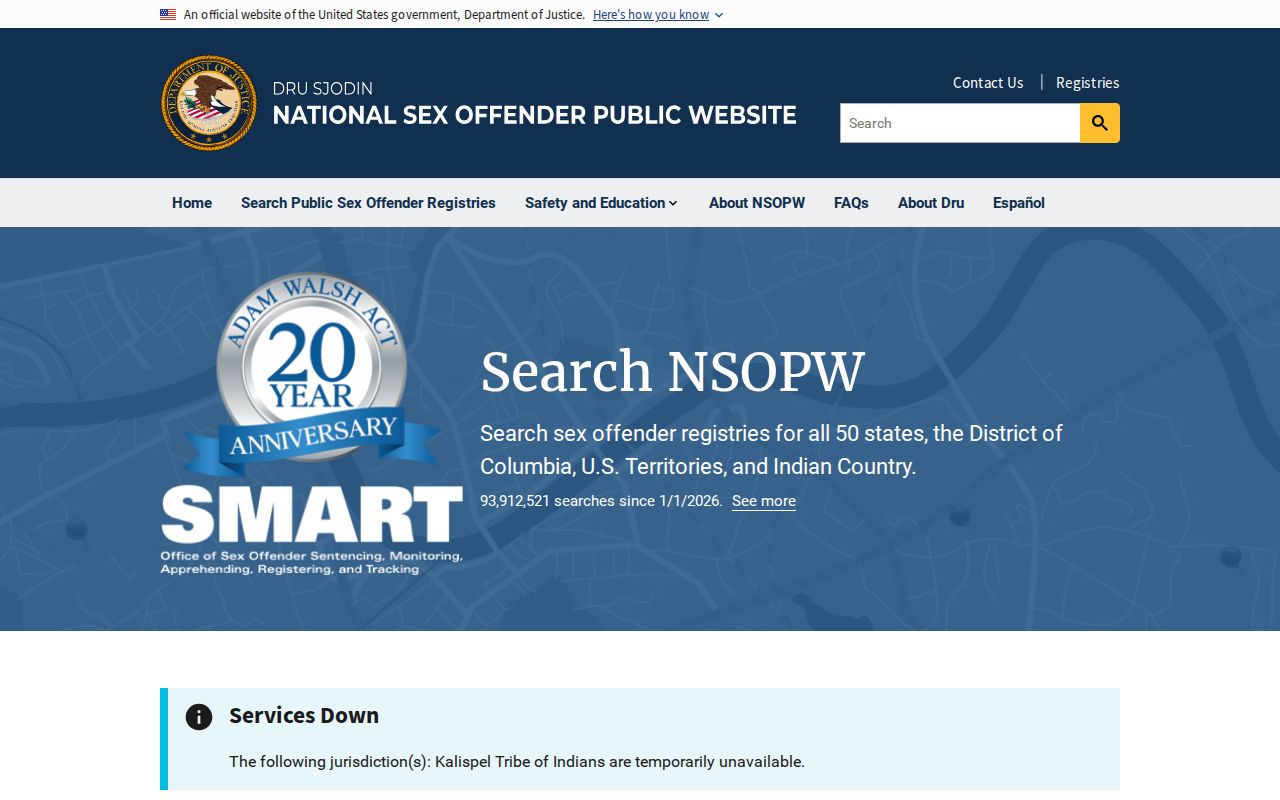
This national layer is useful for cross-state awareness without relying on an unofficial people-search service.
Texas Registration Levels and Requirements
Texas does not use public federal Tier I, II, and III labels as a simple substitute for its own law. Chapter 62 ties duration to the reportable outcome and statutory category. Texas risk assessments use low, moderate, or high labels for predicted danger and notification relevance. Those labels are distinct from whether a duty lasts ten years or for life.
| Concept | Duration or Effect | Source |
|---|---|---|
| 10-year duty after discharge | Applies to listed reportable outcomes not assigned lifetime duty; the statutory start follows release or discharge rules | CCP Art. 62.101 |
| Lifetime duty | Applies to listed serious, repeat, and other statutory categories | CCP Art. 62.101 |
| Low, moderate, or high risk | Describes assessment and notification relevance, not the length of registration | Chapter 62 risk rules |
| Civilly committed or high risk | May trigger English and Spanish community notice when a qualifying person is released or moves | DPS program guidance |
Texas registration began September 1, 1991. A 1997 change reached certain adjudications after September 1, 1970 when the person was still in the justice system for that offense on or after September 1, 1997. Registrants must verify as required and promptly report covered changes. Failure to comply may be prosecuted as a felony.
Calhoun County Registry Subscriptions
The redesigned DPS registry includes record subscription controls. When a profile offers that action, a reader can use email notice as a supplement to a later manual check. Subscriptions are useful when a specific public record changes, but they do not turn the registry into a live movement alert.
Check the whole profile again after a notice. A status, address, photograph, vehicle entry, or other published field may have changed, and each field needs its own context. Questions about a Calhoun County registration should still go to the authority named in the profile. DPS program staff can be reached at 512-424-2800 for statewide registry questions.
Correcting Calhoun County Record Questions
A registry question should first be separated from a general criminal-history correction. For a public registration detail, contact the registering law-enforcement authority shown on the profile. For a broader Texas criminal-history error, DPS maintains a separate resolution process. Those are different systems, and sending a registry concern into the wrong channel can slow review.
The DPS error-resolution page is the official source for Texas criminal-history correction steps.
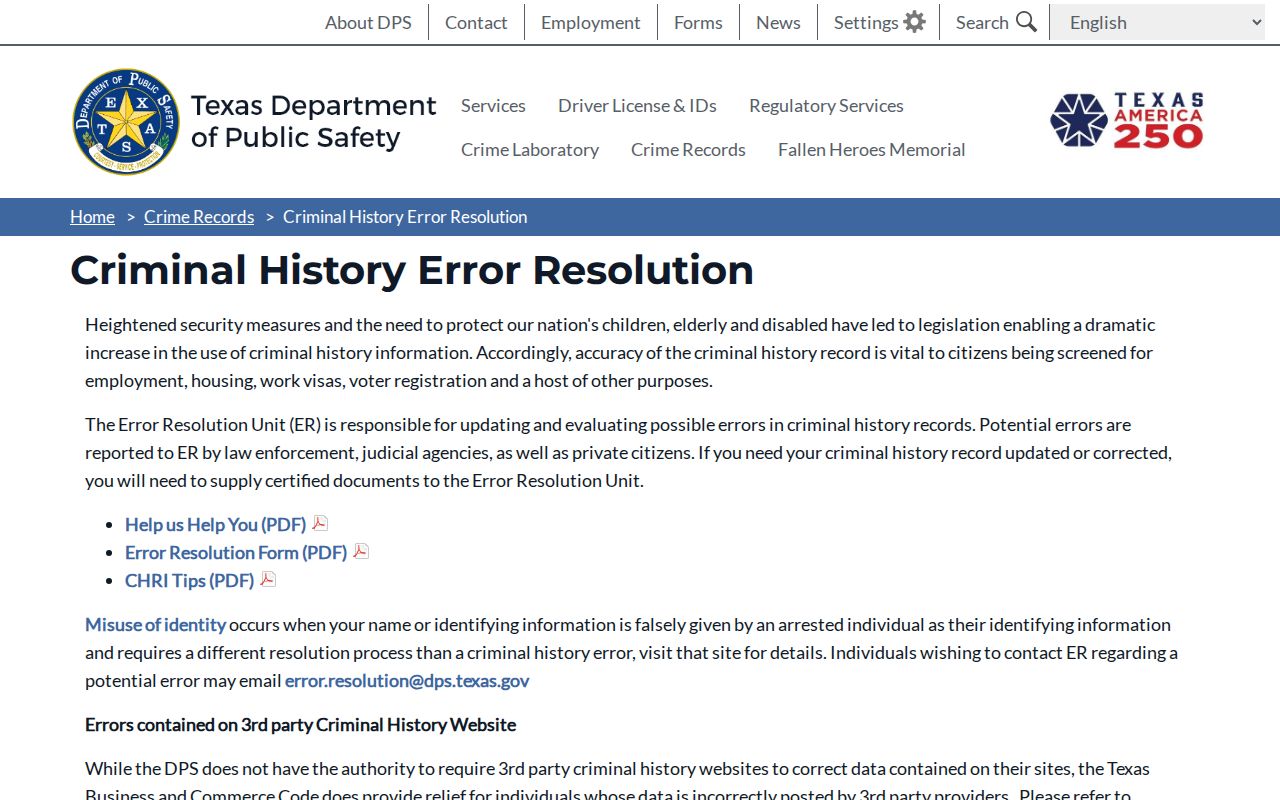
The state instructions help distinguish a repository correction from a current registration or compliance report.
Community Notification and Lawful Use
Calhoun County registry information supports personal, family, neighborhood, and community awareness. Texas may use broader notice for qualifying civilly committed or high-risk releases, including English and Spanish mail notice to the immediate community. Public profile and map access also let residents review information without direct contact.
If suspected noncompliance appears, save the public record details and report the concern to local law enforcement. Do not investigate at a residence, publish accusations beyond the official record, or confront a registrant or household. The governing Texas Code of Criminal Procedure Chapter 62 sets registration and notification rules and protects specified information.
Use registry information lawfully: Texas law forbids using registry information to injure, harass, or commit a crime. Report suspected noncompliance to law enforcement without confrontation.